Nobody warns you about Primary 5.
One day your child is breezing through multiplication tables and simple fractions, and the next, you are both staring at a problem sum that seems to require knowledge nobody taught you either. It happens fast, and it catches a lot of families off guard.
The jump in difficulty between lower and upper primary is real. And for many children, it is the point where a quiet confidence in Maths starts to quietly unravel.
The syllabus is harder than most parents grew up with
This is not nostalgia talking. Singapore’s Primary Maths curriculum has been deliberately designed to go beyond procedures and formulas.
Children are expected to reason through unfamiliar problems, not just apply a method they have memorised. A PSLE question might wrap fractions, ratios, and a real-world scenario into a single word problem, and the child has to figure out where to even begin. That kind of thinking takes time to develop. It does not come from drilling ten similar questions in a row.
The Ministry of Education’s PSLE Maths syllabus is publicly available and worth reading if you have not already. Seeing what is actually expected at each level can be a useful wake-up call, in the best possible sense.
Knowing the exam format changes how you prepare
A lot of revision happens without much thought given to what the exam actually looks like. That is a missed opportunity.
PSLE Maths runs across two papers. Paper 1 has no calculator and covers multiple choice and short answer questions, worth 45 marks in total. It rewards speed, mental fluency, and a solid grip on the basics. Paper 2 allows a calculator and is worth 55 marks. The questions are longer, often multi-part, and students are expected to show their working throughout.
That working piece matters more than most people realise. Marks are awarded for method, not just the final answer. A child who sets out their thinking clearly can pick up partial credit even when they make an error along the way. A child who only writes the answer, right or wrong, gets nothing for their effort on that question.
Once parents understand this, the goal of revision starts to shift. It becomes less about getting correct answers and more about building the habit of thinking on paper, step by step.
Gaps build up quietly, then announce themselves loudly
Here is the thing about Primary Maths. Every topic leans on something that came before it.
Fractions feed into ratios. Ratios connect to percentages. Percentages show up inside speed and distance problems. If any one of those foundations is soft, the topics that follow become harder than they need to be. And because the gaps are usually subtle at first, they often go unnoticed until a test result makes them impossible to ignore.
A child who nodded along during a fraction lesson in Primary 3, understanding just enough to get by, might carry that half-formed understanding all the way into Primary 6 without anyone catching it. By then, the fix takes considerably more time and effort than it would have earlier.
This is not about blame. It just means that waiting for things to feel urgent is rarely the right strategy with Maths.
What revision actually looks like when it works
There is a lot of advice floating around about PSLE preparation. Most of it is not wrong exactly, just incomplete.
Consistent practice over time genuinely matters. Not three-hour weekend sessions that leave a child mentally exhausted, but shorter, focused practice done regularly. Twenty to thirty minutes most days will outperform a Sunday marathon almost every time when it comes to retaining mathematical thinking.
Reviewing mistakes properly matters just as much as the practice itself. Not just correcting the answer, but sitting with the question long enough to understand where the thinking went wrong. That is the part most children skip, and it is the part that actually closes gaps.
Past papers from the Singapore Examinations and Assessment Board (SEAB) are worth using throughout preparation, not just in the final weeks. Familiarity with the question format and the pacing of both papers reduces exam-day anxiety considerably.
When home revision stops being enough
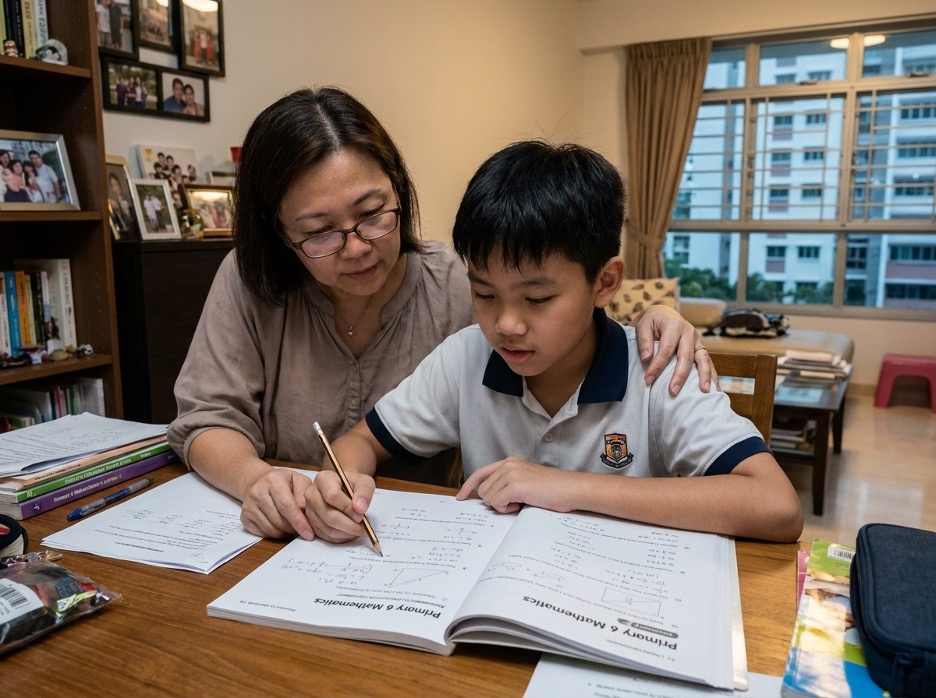
There is a point, and most parents know it when they reach it, where sitting beside your child and trying to explain a problem sum just is not working anymore.
Maybe the method you remember is different from what they were taught in school. Maybe your child shuts down when you correct them. Maybe the gaps have grown to the point where one patient parent at a kitchen table is not the right tool for the job.
That is completely normal, and it is not a failure on anyone’s part. It is just a signal that more structured support might help.
Good PSLE Maths tuition in Singapore is not about adding more pressure. It is about finding someone who can identify exactly where a child is stuck, explain things differently from how school explained them, and rebuild confidence alongside competence. Small group settings tend to work particularly well for primary school children because the attention is personal without the intensity of being one-on-one with a tutor the whole time.
Earlier is almost always better
If you are already in Primary 6 and reading this, there is still time. A focused few months with the right support can shift things meaningfully.
But if your child is in Primary 4 or 5 and you have been noticing signs of struggle, this is genuinely the better moment to act. Not because the PSLE is imminent, but because there is enough time to actually fix things properly rather than patch them in a rush.
The parents who tend to feel calmest during PSLE season are usually the ones who started paying attention a year or two before everyone else did.
One last thing about keeping it in perspective
PSLE Maths is important. It is also one exam, taken on one day, by a child who is eleven or twelve years old.
The habits your child builds during this preparation period, how they deal with problems they cannot immediately solve, how they manage their time, how they pick themselves up after a difficult practice session, are going to matter long after the results are out. Keep the focus on progress and genuine understanding, and the results tend to take care of themselves.
A child who walks into the exam room feeling steady and prepared will almost always do better than one who walks in exhausted and anxious, regardless of how many hours they have put in.
That is worth remembering when the revision schedule starts to feel like it is taking over everything.